The Real Price of a Cheap Pressure Transmitter
The quote I was proud of
In late August 2022, I pulled a quote for an Endress+Hauser pressure transmitter that came in 11% under our usual distributor. I remember forwarding the PDF to our procurement lead thinking: that's how you buy.
Four days later, the box arrived. I signed for it. The model code started with PMC71- — same as the one we'd used before. I checked it against the old purchase order at a glance, saw the prefix matched, and moved on.
Six days after that, we had the transmitter on the pipe. It powered up reading 30 bar and stayed there. Our working pressure was 40 bar. The device we'd received — same housing, same process connection — was a 0.4–16 bar unit. The wetted diaphragm was 316L stainless; we needed Hastelloy for the chloride-laden steam environment. I'd missed the range code and the material code, both compressed into four-character alphanumerics on the quote sheet, sitting right next to options that looked nearly identical.
On paper, the quote was correct. In the plant, it shut us down for four days. When we added up the return of the wrong part, air freight for the replacement, and weekend overtime, the number came to $28,000 in lost production plus $1,400 in expedited shipping. The discount, the thing I'd been so satisfied with, saved us $190.
The real problem was never the quote
Here's the thing that took me a while to see: that $190 was never the problem. I thought I was buying a price. I was actually buying a date.
Every instrument we run — Endress+Hauser pressure transmitters, our ultrasonic flow meters, the handheld calibrators, the bench multimeters, even the calipers (Mitutoyo vs Starrett calipers was a debate I had to settle twice before I stopped trusting the 'looks the same' argument) — every one of those was evaluated, in the end, not on the spec sheet but on three things: did it arrive when it was supposed to, was it the exact spec that was quoted, and did it survive the first week in the field.
The mistake I made wasn't choosing the wrong vendor. It was treating procurement as a price comparison when it's actually a risk calculation. The price of the part was $1,540. The price of getting the part wrong was $29,400. These are not two numbers of the same kind.
The cost of being wrong is asymmetric
I learned this the hard way a second time before it stuck.
In January 2023, we ordered an Endress+Hauser ultrasonic flow meter from the same discount channel. I was more careful this time — I verified the full model code, field by field, against the manufacturer's selection tool. I caught the range and the material before the PO went out. I was proud of that.
They got me a different way: the delivery date. Promised in three weeks, arrived in five. No update, no apology. When I called to ask, I got 'factory scheduling' — as if that explained anything.
The plant didn't stop that time, because we had a spare on the shelf. But we burned two shifts rearranging the install, and we missed a preventive maintenance window that cascaded into about six weeks of rescheduling.
I started a document that January. Every instrumentation order where something went wrong — what it cost, what caused it, what the right move would've been. That document is how I learned that the thing I was buying when I paid the discount price was uncertainty. And uncertainty, in a plant with a production schedule, is the most expensive thing on the quote.
The checklist I now use
I run every instrumentation purchase order through four checks now. Not because I'm a checklist person by nature — I'm not — but because I have $28,000 of scar tissue telling me I should be.
Spec check — read the code, not the description. For Endress+Hauser equipment, I break the full model code into its parts and verify each one against the selection tool. Range and wetted material are the two fields that get missed most often, and they're the hardest to correct after the fact. (Note to self: the prefix being right doesn't mean the whole code is right.)
Delivery check — get a date, not a window. 'Three to five weeks' is not a date. 'Friday the 12th' is. I'll pay extra for the certainty — I've done the math, and a premium that keeps a line running for even one extra shift pays for itself. After being burned twice by 'probably on time,' I stop arguing with myself about this one.
Channel check — an authorized distributor gives you a returns window. No returns window, no real discount. This is the adjustment I made after the second incident.
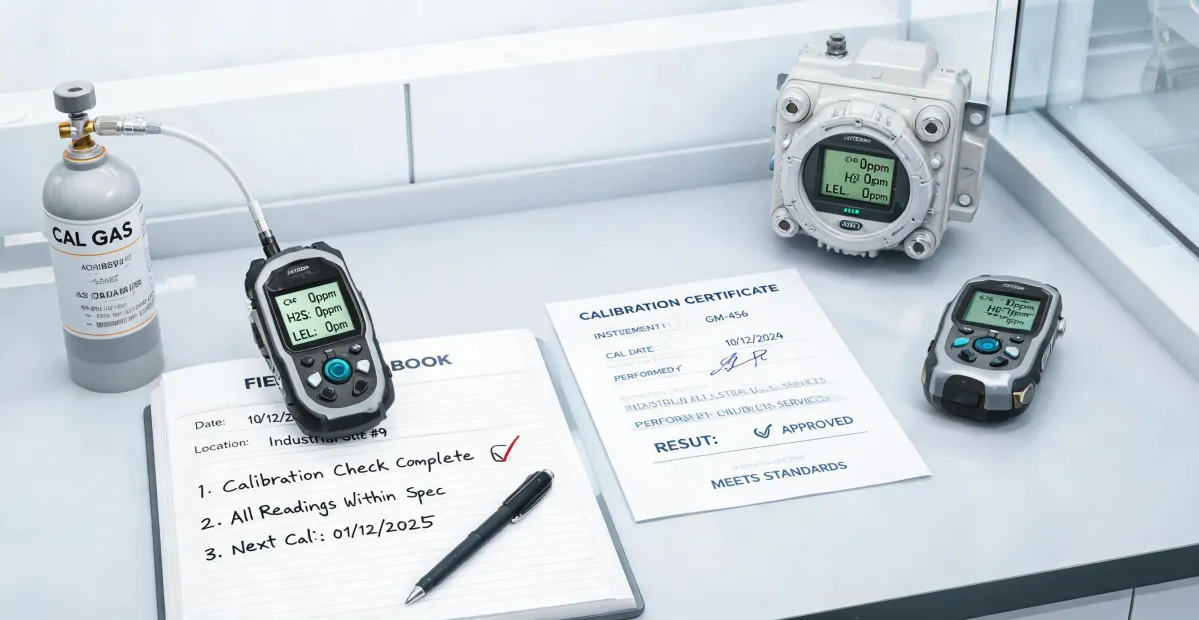
Traceability check — the calibration certificate has a signature. Per NIST's guidelines on measurement traceability (SP 811, accessed January 2025), traceability means an unbroken chain of calibrations linking the measurement to NIST reference standards. In our context: a certificate you can check line by line, not a 'calibrated' stamp in the corner of the quote.
The same discipline applies to the small stuff. An 87-5 industrial multimeter, a handheld unit you connect to a multimeter loop to verify 4-20mA signal integrity, a set of Mitutoyo calipers — all of these need the same provenance that a pressure transmitter does. When a price on a Mitutoyo caliper is too low to be true, the channel is almost always the problem, not the tool. I've had to flag this a handful of times now, and in every case it came down to the same question: which distributor — and do they stand behind what they sold you.
What I do differently now
I plan procurement earlier than I used to. I hold harder line items on the terms. I pay for three things that aren't in the headline price: a guaranteed delivery date, a returns window, and a traceable calibration certificate. The first cut down the schedule risk; the other two catch it when it still slips through.
The premium, averaged across the year, is somewhere between 6 and 12% depending on lead time and part availability. That's more than the $190 I 'saved.' It is dramatically less than the $28,000 I didn't.
I still feel a small pull toward the lowest quote when I see one. That instinct doesn't go away. What I've learned to ask instead of 'how much can I save' is 'if this price is wrong, how much does being wrong cost?' Sometimes the answer is 'it doesn't matter, we're not on a deadline.' When it does matter — and in a running plant, it usually does — the math tends to settle itself.
A shorter way to put it
If you take one thing from this: the next time a cheap instrumentation quote looks like a good deal, don't ask what it saves. Ask what it costs if it's wrong. The answer probably won't be $190.
The transmitter taught me a lesson. The two orders that came before it taught me the expensive one. I'd rather pass the expensive version along.

Marcus Feld
Marcus Feld is an electrical test and measurement analyst specializing in multimeters, oscilloscopes, clamp meters, insulation testers, spectrum analyzers, and data loggers. He applies IEC 61010-2-030 and IEC 61010-031 concepts while examining measurement category, bandwidth, true-RMS response, input loading, and stated uncertainty. His work helps maintenance engineers and test teams choose safe instruments with performance suited to the signals and environments they actually measure.
Leave a Reply